
Digital advocacy depends on understanding how people feel—not just whether they take action. Traditionally, organizations have relied on surveys, polls, and focus groups to capture public opinion. But these methods often create too much noise, too many options, and unclear direction. A Sentiment Widget offers a fundamentally different approach to gathering sentiment—one that is simpler, clearer, and far more actionable for modern digital advocacy campaigns.
A Sentiment Widget is not a survey. Instead of asking advocates to answer long questionnaires or choose from dozens of options, an organization proposes a clear idea—their idea—and asks advocates one simple question: Do you support this or not? That simplicity is the power. Rather than asking people what they want (which rarely leads to consensus), organizations can state their intent plainly and measure how advocates feel about it. This removes ambiguity and delivers clean, focused sentiment data that leaders can actually use.
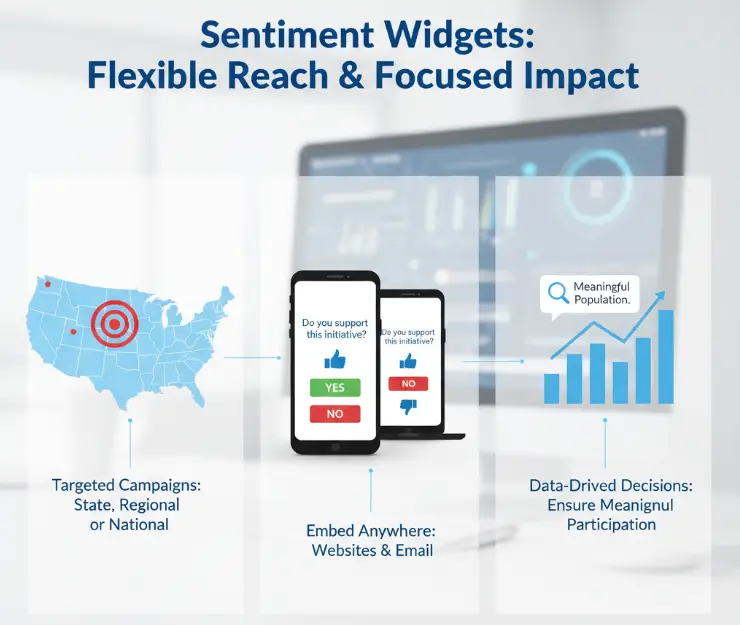
What makes sentiment especially valuable in digital advocacy is its flexibility and reach. A Sentiment Widget can be targeted to a single state, a specific region, or the entire nation. It can be embedded directly on any website—ensuring members or visitors see it—or delivered via email as part of a broader digital campaign. For organizations concerned about sample size or reach, One Click Politics offers multiple options for acquiring advocates and expanding participation, ensuring sentiment results reflect a meaningful population.
Sentiment campaigns are particularly powerful in environments like unions, associations, and membership-driven organizations. For example, union leadership may want to understand how members feel about a proposed policy change or negotiation stance. Instead of asking open-ended questions, leadership can propose the direction they intend to take and gather sentiment directly from members. This approach provides clarity at the top while still respecting member input—and delivers concrete data leaders can stand behind when making decisions.
Unlike traditional polling organizations such as Pew Research Center and Gallup, which rely on external surveys and poll aggregation, a Sentiment Widget puts sentiment measurement directly in the hands of the organization. While public opinion strategies and poll aggregators—such as FiveThirtyEight-style models and academic polling frameworks—play an important role in understanding national trends, sentiment widgets allow organizations to collect issue-specific, geographically targeted sentiment in real time, all from a single platform.
The strategic value of sentiment data extends far beyond internal insight. Sentiments can be used as ammunition for advocacy campaigns—not just showing how many people took action, but demonstrating how people feel in a specific district, state, or region. For example, an organization planning to build a data center could deploy sentiment widgets across targeted communities to identify areas with the least resistance, refine messaging, and even influence policymakers by presenting localized sentiment data. This turns digital advocacy into a strategic decision-making tool, not just a mobilization tactic.
Sentiment Widgets are supported and guided by advocacy experts at One Click Politics, who help organizations design, deploy, and interpret sentiment campaigns effectively. Whether embedded on a website, delivered via email, or paired with broader digital advocacy efforts, sentiment campaigns offer endless use cases—from shaping public policy to guiding infrastructure decisions. With expert support, integrated data, and flexible deployment, sentiment widgets represent the next evolution of digital advocacy—clear, focused, and built for action.
Visit One Click Politics – To schedule a demo today and speak with experts on how sentiment campaigns can be used in combination with digital advocacy to drive change.