
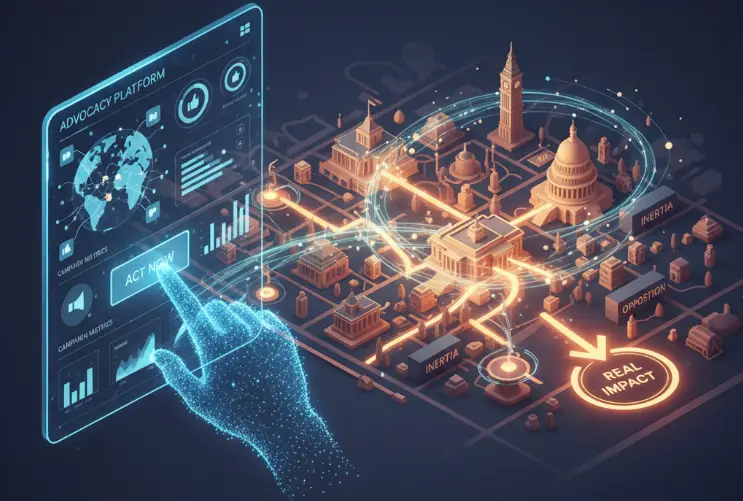
Political campaigns used to be about yard signs, phone banks, and direct mail. Today, they’re powered by data, digital infrastructure, and organized networks of advocates.
If you’re searching for advocacy software to power a political campaign, you’re not just looking for a tool. You’re looking for leverage.
This article breaks down the theory behind modern political campaigns, how advocates actually influence public policy, and why structured digital advocacy platforms are now central to political impact.
The Evolution of Political Campaign Theory
Political campaign strategy has always revolved around three pillars:
- Message
- Mobilization
- Momentum
In traditional campaign theory, the goal was persuasion at scale. According to research from the Pew Research Center, over 70% of Americans say they follow national political news at least somewhat closely. That means message saturation matters.
But message alone doesn’t move policy.
Political scientists increasingly emphasize collective action theory — the idea that organized groups influence outcomes more effectively than individuals acting alone.
The Brookings Institution has repeatedly highlighted that policymakers are more responsive to organized, repeated, and structured communication than to sporadic outreach.
This is where advocacy software enters the picture.
Why Advocates Matter More Than Ever
An advocate is not just a supporter.
An advocate is someone who:
- Takes action
- Contacts decision-makers
- Shares messaging
- Recruits others
- Signals public sentiment
Research published in the American Political Science Review found that direct constituent communication increases legislative attention and responsiveness, particularly when messages are coordinated and issue-specific.
Additionally, the Data & Marketing Association reports that personalized messaging can increase engagement rates by more than 20% compared to generic outreach.
Political impact happens when:
- Messaging is consistent
- Volume is measurable
- Geographic distribution is visible
- Participation is documented
Advocacy software allows campaigns to do exactly that.
The Numbers Behind Modern Political Mobilization
Let’s look at the data:
- According to the U.S. Census Bureau, nearly 66% of eligible voters participated in the 2020 presidential election — the highest rate in over a century.
- The Pew Research Center reports that 53% of Americans have taken at least one political action beyond voting (such as signing a petition or contacting an official).
- More than 85% of Americans use the internet daily, according to Pew — making digital advocacy the dominant channel for engagement.
- Email marketing benchmarks show average engagement rates between 15–25%, with political lists often outperforming commercial lists due to high emotional investment.
The implication?
Digital advocates are not passive. They are primed for action.
But without structure, their impact becomes diluted.
Political Campaign Theory: Volume + Visibility = Influence
There’s a concept in campaign strategy called signal amplification.
Decision-makers are influenced by:
- The number of people taking action
- The clarity of the demand
- The perceived intensity of support
- The visibility of the issue
According to the Congressional Management Foundation, congressional offices prioritize constituent communications that are:
- Personalized
- Organized
- Issue-focused
- Repeated over time
Advocacy software makes it possible to:
- Track advocate engagement
- Standardize issue framing
- Capture data for impact reporting
- Demonstrate scale
Without a system, advocacy becomes noise.
With a platform, it becomes measurable political pressure.
Digital Grassroots vs. Traditional Campaigning
Traditional political influence relied on:
- Lobbyists
- Direct mail
- In-person meetings
- Fundraising events
Today’s campaigns rely on:
- Email mobilization
- Social sharing
- Embedded action widgets
- Rapid-response digital pages
- Data dashboards
The Center for Responsive Politics reports billions spent annually on political influence and lobbying.
Yet digital grassroots advocacy often costs a fraction of traditional lobbying efforts while producing scalable engagement.
Advocacy software democratizes influence.
It gives organizations the infrastructure to:
- Activate thousands in hours
- Launch rapid campaigns
- Measure sentiment
- Deliver impact summaries
The Psychology of Advocacy
Research from behavioral science suggests people are more likely to take political action when:
- The action is easy
- The message is clear
- The impact feels tangible
- The social proof is visible
This aligns with what the Harvard Kennedy School describes as “participatory reinforcement” — the idea that engagement increases when individuals see others participating.
Advocacy software platforms enable:
- Real-time participation counters
- Geographic heat maps
- Shareable confirmation pages
- Public-facing metrics
When advocates see momentum, they create more momentum.
From Digital Action to Political Impact
Effective advocacy software doesn’t just send emails.
It creates:
- Structured campaign messaging
- Advocate databases
- Geographic reporting
- Executive impact summaries
- Deliverables for policymakers
Modern political campaigns depend on measurable impact. Data isn’t optional — it’s strategic currency.
Organizations that can say:
“10,482 advocates across 42 states took action in 14 days”
carry more weight than those that say:
“People care about this issue.”
Campaign theory is clear: numbers persuade.