
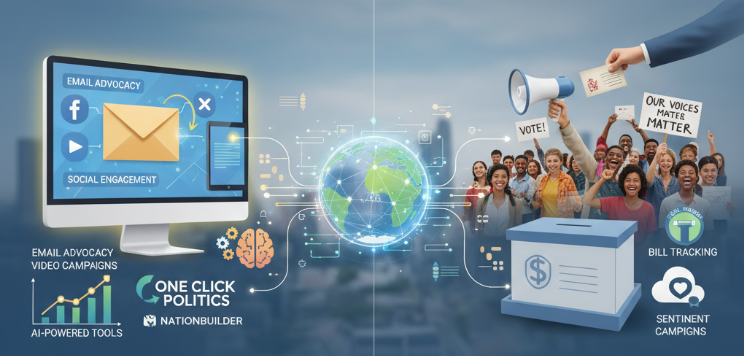
Digital advocacy has become one of the most effective ways organizations mobilize supporters, influence policy, and create measurable change. At its core, digital advocacy uses online tools—such as email, video, and social engagement—to connect advocates directly with decision-makers. While some argue that digital advocacy is losing relevance, the reality is the opposite: it has evolved. Organizations that adapt their strategy to include personalization, analytics, and multi-channel engagement continue to see strong results.
Email remains the foundation of digital advocacy campaigns because it provides a direct, trackable, and scalable way to engage advocates. Lawmakers and their staff still rely heavily on email for constituent communication, making email advocacy a critical channel for policy influence. Claims that email advocacy is “dying” usually stem from overuse of generic messages. Targeted, well-timed, and authentic digital advocacy emails consistently outperform unfocused outreach and remain essential to modern campaigns.
As digital advocacy has matured, video campaigns have emerged as a powerful complement to email advocacy. Video allows advocates to share personal stories, emotion, and urgency in ways text alone cannot. This format increases engagement and message retention, especially on social platforms where visual content dominates. Advocacy platforms like One Click Politics support multiple campaign types—including video—giving organizations flexibility to choose the most effective digital advocacy tools for their goals.
Strong digital advocacy is not just about channels—it’s about intelligence and execution. One Click Politics pairs advocacy experts with AI-powered tools to help organizations write impactful messages and target the right audience. These tools support message creation, audience targeting, and delivery to the appropriate policymakers. The platform also includes bill tracking to align digital advocacy efforts with active legislation, as well as a new feature called Sentiment Campaigns, which captures how advocates feel about an issue, adding depth beyond traditional action metrics.
Analytics are essential to successful digital advocacy. Understanding who engages, how often they take action, and which messages resonate allows organizations to continuously refine their campaigns. Advocacy analytics help identify top advocates, optimize messaging, and demonstrate impact to stakeholders. Tools like NationBuilder (https://nationbuilder.com) highlight the value of combining advocacy data with supporter information. While CRM functionality does not need to be complex, maintaining organized advocate data is critical for long-term digital advocacy success.The future of digital advocacy lies in Campaign as a Service, a new model that blends digital action with tangible, grassroots impact. Campaign as a Service combines online advocacy—such as email and video—with physical assets like handwritten letters, postcards, and community-driven outreach. This approach shifts advocacy from being organization-led to advocate-powered, encouraging supporters to amplify campaigns through social sharing, personal networks, and real-world engagement. By uniting digital advocacy, physical assets, and advocate-driven momentum, Campaign as a Service creates authentic, scalable impact that decision-makers cannot ignore.